

A REACH-compliant PMU pigment is a permanent makeup mixture whose formulation, labeling and documentation meet the EU restriction on tattoo inks and permanent makeup, which has applied across the EU/EEA since 4 January 2022. For professionals buying pigments, compliance is something you confirm on the label and in the supplier’s paperwork, not a marketing phrase. BVShop (Beauty Visit Shop) supplies professional PMU pigments and related supplies, so this guide covers what the rule restricts, what to check before each purchase, and how to record it in your studio.
Key Takeaways
- The restriction sits in Entry 75 of REACH Annex XVII and covers PMU, microblading and micro-pigmentation in the same way as tattoo inks.
- Compliance is shown by the required label statements, a batch reference, a full ingredient list and current supplier documents, not by words such as “organic” or “vegan”.
- Keep invoices, product information and the pigment and lot number for every treatment.
- Rules outside the EU differ by country and state, so check the authority for the market where you work.
Table of Contents
- What REACH Means for PMU Pigments
- Which Substances Are Restricted
- What Compliance Does and Does Not Tell You
- How to Verify a PMU Pigment Before You Buy
- Keeping Records in Your Studio
- Composition, Shade Identification and Claims
- Healed Results After the Switch
- Working Outside the EU
- Shopping for Compliant Pigments at BVShop
- FAQ
- Sources
What REACH Means for PMU Pigments
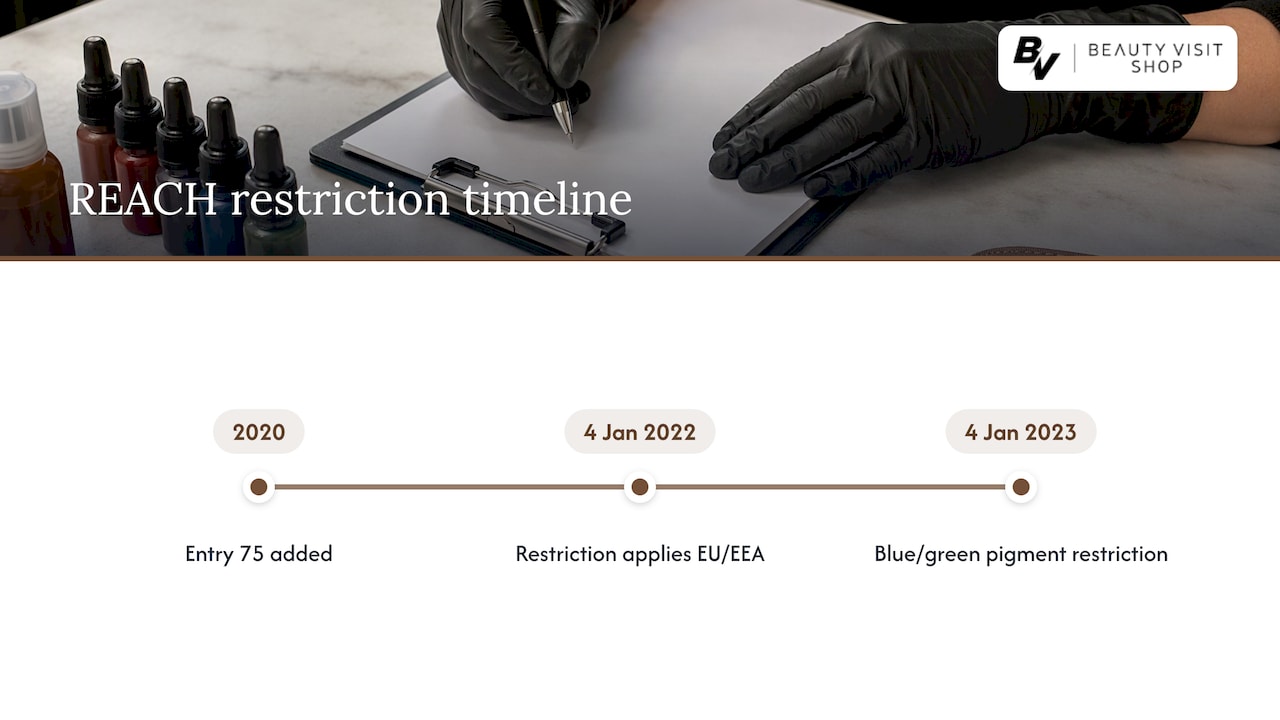
REACH is the EU’s chemicals regulation. Commission Regulation (EU) 2020/2081 added a restriction on substances in tattoo inks and permanent makeup to Annex XVII (Entry 75). Its definition of tattooing includes injecting or introducing a mixture into the skin by any procedure, naming permanent makeup, cosmetic tattooing, microblading and micro-pigmentation. A PMU pigment is therefore covered by exactly the same entry as a tattoo ink.
ECHA, the European Chemicals Agency, states that the restriction limits more than 4,000 hazardous chemicals and applied in the EU/EEA from 4 January 2022. Pigment Blue 15:3 and Pigment Green 7 followed on 4 January 2023, after a 24-month transition. ECHA also states that the aim is not to ban tattooing but to make the colors used in tattoos and permanent makeup safer.
Who carries the responsibility
The Swedish Medical Products Agency explains that manufacturers within the EU/EEA and importers into it are responsible for verifying that products stay within the Entry 75 concentration limits. That is why the paperwork should come from the manufacturer or supplier, and why you should keep it on file.
Which Substances Are Restricted
Entry 75 works by category and by concentration. According to the regulation text:
- Substances classified as carcinogenic or germ cell mutagenic (categories 1A, 1B and 2) may not be present at or above 0.00005% by weight.
- Reproductive toxicants and skin sensitizers of the same categories are limited to 0.001% by weight.
- Corrosive, irritant and eye-hazard substances are limited at 0.01%, or 0.1% where used as a pH regulator.
- Substances prohibited in cosmetics (CPR Annex II) are limited at 0.00005%.
- Specific substances in Appendix 13 carry their own limits. Mercury, cadmium, chromium, cobalt and arsenic are set at 0.00005%, nickel at 0.0005%, copper at 0.025% and zinc at 0.2%.
ECHA adds that the restriction will automatically extend to any substance that gains an EU-wide classification in these hazard groups. A pigment that was compliant last year can therefore be affected by a later classification, which is a reason to ask for current documents rather than rely on an old certificate.
Impurities matter as much as ingredients
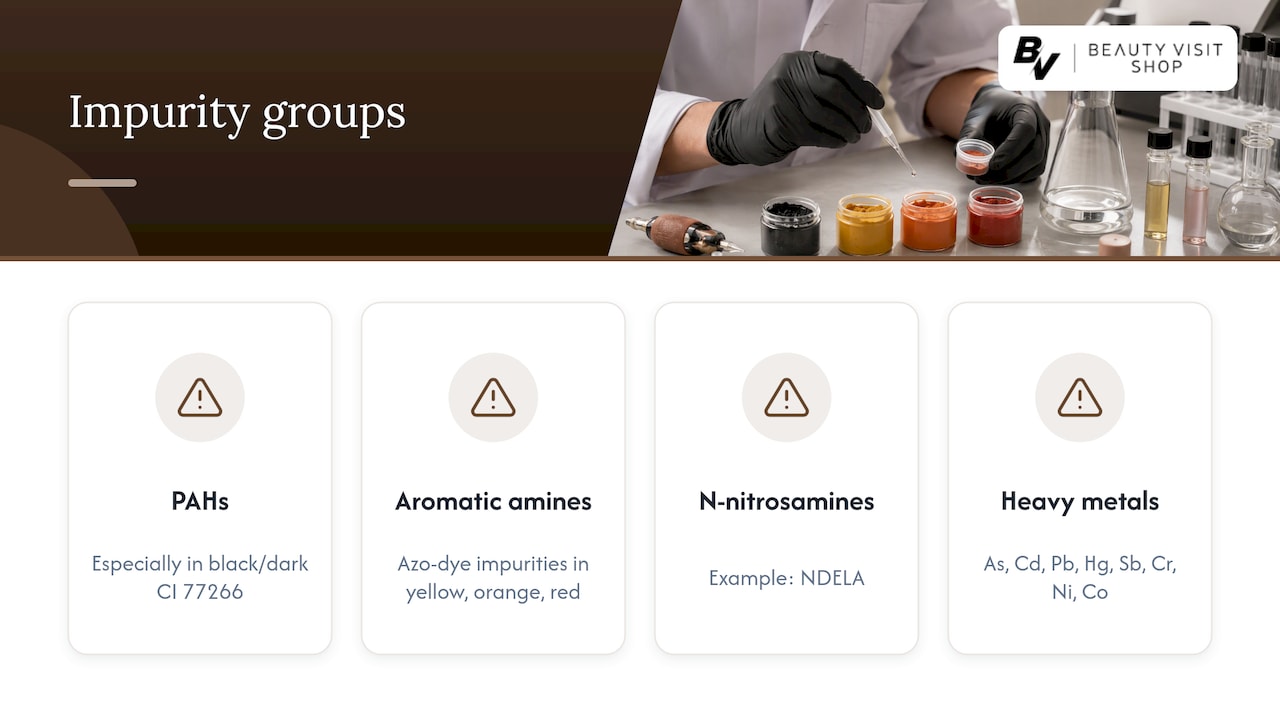
The Saxon state testing agency LUA Sachsen names the substances most critical to verify as absent: carcinogenic PAHs (especially in black and dark colors based on CI 77266), primary aromatic amines as impurities of azo dyes in yellow, orange and red shades, N-nitrosamines such as NDELA, and heavy metals including arsenic, cadmium, lead, mercury, antimony, chromium, nickel and cobalt. This is why a batch-linked test report says more than an ingredient list alone.
What Compliance Does and Does Not Tell You
REACH does not create a single “safe ink” certificate. Annex XVII restricts specified substances and sets information duties for mixtures. A 2026 analysis from a tattoo-ink supplier notes that descriptors such as vegan, organic, sterile or professional grade are not regulatory conclusions and do not replace Annex XVII evidence. The practical question is whether the formulation complies with every applicable restriction for the substances, impurities and classifications it contains.
In day-to-day buying, that means a phrase on a bottle is a starting point, and the label statement plus supplier documents are the proof.
How to Verify a PMU Pigment Before You Buy
Use the same routine for every new pigment line and for every restock.
- Read the required label statement. Under the regulation, the label must state “Mixture for use in tattoos or permanent make-up”. A mixture without the required statement may not be used for tattooing purposes.
- Find the batch reference. Each package needs a unique reference number that identifies the batch.
- Check the ingredient list. It must be complete, in descending order by weight or volume, using common ingredient names or IUPAC, CAS or EC numbers. LUA Sachsen adds that group names such as “preservatives” without individual listing are not acceptable.
- Look for the nickel and chromium (VI) statements. Where either is present below the Appendix 13 limit, the label must carry the matching allergy statement.
- Confirm manufacturer details and shelf life. LUA Sachsen advises rejecting colors that lack the manufacturer’s name and address or shelf-life information. The JRC compilation also lists conditions of use, warnings and a sterility guarantee among recommended packaging information.
- Request current documents. LUA Sachsen advises demanding current analysis certificates from the manufacturer or supplier confirming compliance. The 2026 supplier analysis cited above lists a market-specific safety data sheet, full colour-index disclosure, batch-linked test reports and a declaration of compliance with Entry 75.
What a test report should show
The German BfR’s opinion on minimum requirements and test methods states that analytical methods should reproducibly determine substances within the REACH limits, be performed under GLP or ISO/IEC 17025, and cover both intentionally added ingredients and impurities. When you read a report, check that it names the batch and the method, not only a general conclusion.
Where BVShop fits in this routine
BVShop positions its catalog to help professional buyers compare pigment options and find relevant supplies in one place. Before you order, compare the product page and the manufacturer’s own documentation against the checklist above, and use the label and batch details on the delivered bottle for your records. For a deeper look at what a label should carry, see our guide to REACH-compliant tattoo inks: what to verify and our overview of tattoo ink ingredients, carriers and labels.
Keeping Records in Your Studio
The PMU Quality Register guide recommends buying only from suppliers that demonstrably supply REACH-compliant products, keeping invoices and product information, not using old pre-restriction stock, and recording the pigment and lot number for each treatment. A simple log works:
| Record | Why it matters |
|---|---|
| Product name and shade | Identifies exactly what was implanted |
| Lot or batch number | Links the treatment to the batch documents |
| Invoice and supplier | Shows where the product came from |
| Safety data sheet and test report on file | Supports your compliance if you are asked |
| Opening date and shelf-life date | Keeps expired product out of use |
LUA Sachsen notes that official sampling of tattoo and PMU colors is done unannounced at manufacturers, in trade and at practitioners under German law, so keeping these records ready is simply good practice.
Composition, Shade Identification and Claims
A review in Cosmetics (Andreou et al., 2021) explains that inorganic pigments are characterized by iron-oxide content, which adds solid color, opacity and a wider shade range. Titanium dioxide prevails in lighter shades and iron oxides in darker ones. The review reports that inorganic pigments are least likely to cause allergic reactions, while organic pigments fade more easily in sunlight, which is why they suit semi-permanent PMU. It also notes that machine work tends to give better results with inorganic colors, whereas manual microblading often gives a more natural result with organic colors.
For your selection, this means reading composition as a working property: undertone, opacity, and how the pigment suits the technique and the client’s skin. Claims such as “iron-oxide-free” or “organic” describe formulation, and compliance is still confirmed through the label and documents.
BVShop publishes line-by-line color guides to help with that comparison:
- The Pigment PMU pigments, color systems for brows, lips, eyes and correction work
- PhiAcademy pigments for microblading and PMU
- Etalon Mix pigments for brows, lips and eyelids
- AS Company pigments and their color guide
- BIOTEK pigments, a complete color guide
- FACE pigments for matching PMU work
Healed Results After the Switch
Some artists report differences in healed color since the restriction. The evidence base is still limited, but a few points help explain why results can vary. The ECHA restriction dossier explains that PMU is often applied more superficially than decorative tattooing, so some colorant is eliminated spontaneously, and remaining particles are held in dermal macrophages and fibroblasts. That makes depth, skin type and pigment choice central to stability.
The BfR’s opinion on Pigment Blue 15:3 and Pigment Green 7 points out that reformulating with substitute pigments, for example partially brominated Pigment Green 36, may change performance because the substitutes are less studied. A 2024 analysis of blue and green inks from five manufacturers found nine of ten inks did not meet REACH requirements, which shows why batch-linked documentation is worth requesting for every color family.
When a shade behaves differently from the one you used before, treat the new formulation as a new product: patch test where your local rules call for it, document the lot, and adjust your color choice and technique.
Working Outside the EU
REACH is an EU/EEA rule, and it should not be carried over to other countries as if it applied everywhere. BAQA advises using the official authority for the market where a product is supplied and used, and notes that the US FDA and EU/EEA REACH describe materially different controls. An international review by JRC and ECHA found that control varies widely: Australia regulates by state or territory, the US has no federal scheme for tattoo inks with state-level requirements instead, and Canada and Japan have no specific central legislation.
In the UK, Northern Ireland continues to apply EU REACH under the Windsor Framework, while Great Britain follows UK REACH. The UK HSE’s opinion proposed compliant inks from suppliers from 2026 and from practitioners from 2027, so confirm the current UK position on the official page.
For studios in the EU, the safe default is simple: buy pigments that carry the Entry 75 label statements and come with current documents, whatever the shade or brand.
Shopping for Compliant Pigments at BVShop
BVShop is an online retailer of professional PMU, microblading, tattoo and beauty supplies, serving professional buyers. Our PMU supplies catalog brings pigments, cartridges, needles and hygiene products together, so you can restock your studio in one order. Product pages list the current details, and shipping terms depend on your destination on bvshop.com.

For specific lines, browse the Quantum Platinum Label Green pigments, the Quantum Platinum Label Reeves pigments or The Pigment PMU Brows Collection. Check each product page and the manufacturer’s documentation for current specifications before ordering.
FAQ
Does REACH apply to microblading pigments?
Yes. The regulation defines tattooing to include permanent makeup, cosmetic tattooing, microblading and micro-pigmentation, so these pigments fall under Entry 75 in the EU/EEA.
Is a pigment that says “organic” or “vegan” automatically REACH compliant?
No. Such descriptors are not regulatory conclusions. Compliance rests on the label statements, the full ingredient list and the manufacturer’s or supplier’s documents for the batch.
Which documents should I keep for each pigment?
Keep the invoice, the product information, the safety data sheet, any batch-linked test report, and a record of the pigment and lot number used for each treatment.
Do the same rules apply in the United States?
No. REACH is an EU/EEA regulation. The US has no federal scheme specific to tattoo inks, and state requirements vary, so check the authority in the place where you work.
Sources
- Commission Regulation (EU) 2020/2081, EUR-Lex
- Regulation 2020/2081, label requirements (PDF)
- Tattoo inks and permanent make-up, ECHA
- ECHA restriction dossier
- Swedish Medical Products Agency, content regulations
- LUA Sachsen, information sheet for tattoo studios
- JRC compilation on the legislative framework
- BfR, minimum requirements and test methods
- BfR, Pigment Blue 15:3 and Pigment Green 7
- Safety of Tattoos and PMU Colorants, Cosmetics 2021
- Analysis of blue and green REACH compliant tattoo inks, 2024
- PMU Quality Register, REACH and PMU pigments
- BAQA, PMU pigment and product traceability
- Safety of tattoos and permanent make-up, final report
- UK HSE, Annex 15 opinion
- UK REACH for tattoo inks, compliance guide
- Poli International, tattoo-ink rules analysis

